


Skip to: content | navigation | search & sites services
UNIDOScope 2004
UNIDO Goodwill Ambassadors believe stronger private sector needed to make Human Development efforts sustainable.
Vienna, Austria, 14 October 2004
![]() |
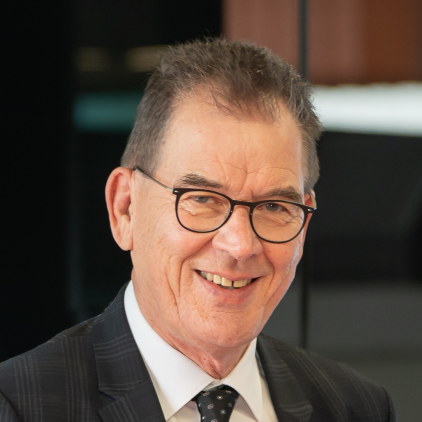
UNIDO Director-General Carlos Magariños has appointed Sir Ronald Grierson and Mamadou Mansour Cama as the first of five UNIDO Goodwill Ambassadors. The Goodwill Ambassadors will champion the core theme of UNIDO the role of productivity enhancement in the overall development process, and the concomitant need for a strong private sector. The ceremony at UNIDO Headquarters in Vienna was opened by the President of the UNIDO Industrial Development Board (IDB), Ambassador Zniber of Morocco (view or download statements) and was attended by representatives of UNIDO member states and UNIDO staff. The Principal Adviser to the Director- General on Strategic Direction, Management and Coordination, Nilmadhab Mohanty made a statement to the assembly (view or download statement) prior to the introduction of the Goodwill Ambassadors and presentation of certificates and medal by the Director- General.
Speaking on the rationale behind the UNIDO Goodwill Ambassador Programme, the UNIDO Director- General pointed out that UNIDO had not taken the "celebrity" approach to Goodwill Ambassadors usually taken by UN Organizations. The UNIDO Goodwill Ambassadors have been selected because of their experience with the private sector and international trade and on the basis of geographic region. They will raise awareness of the strong links between the poverty alleviation aspects of economic growth, private sector development, and participation in international trade. Director-General Magariños believes there is not enough awareness of the critical role that private sector development plays in making human development efforts sustainable. Following the ceremony, the Director-General and UNIDO senior executives had a working session with the new Goodwill Ambassadors on the practical aspects of their advocacy role.
The appointment of the Goodwill Ambassadors to raise awareness of the strong links between the poverty alleviation aspects of economic growth, private sector development, and participation in international trade will augment the improved status these activities have been given by two agreements recently signed by UNIDO, one with the UN Development Programme (UNDP) in September 2004, the other with the WTO in September 2003.
The UNIDO/UNDP joint programme of cooperation on private sector development will implement the recommendations contained in the report of the United Nations Commission on Private Sector and Development entitled Unleashing Entrepreneurship (see UNIDOScope 21 - 27 March 2004 for more) and UNIDOs Corporate Strategy Productivity Enhancement for Social Advance. Unleashing Entrepreneurship challenges Governments to act as facilitators of private sector development and avoid actions that impede it. It says Governments and inter- governmental agencies can facilitate private sector development only by fostering properly functioning competitive markets. The Commission Report says the approach to resolving these issues is simple and the experience well demonstratedwhat it requires is the will to implement change (see UNIDOScope 3 - 9 October).
The UNIDO-WTO Agreement, signed 10 September 2003, further integrates UNIDO's activities in strengthening developing countries' supply side capacities and ability to prove conformity to international standards and regulations on the one hand, with the WTO's activities in strengthening developing countries' capacities to engage in trade negotiations and implement WTO agreements, on the other. UNIDO approved a technical assistance project in January 2004 to begin implementation of the MoU. On 19 July, 2004, a WTO delegation led by WTO Deputy Director - General Kipkorir Aly Azad Rana, who is responsible for WTO technical cooperation and the UNIDO Secretariat presented a Joint Progress Report on the Implementation of the WTO-UNIDO MoU to UNIDO member states at a meeting of UNIDO's Informal Consultative Group on Trade Capacity Building. Dr. Rana said at the meeting that The MOU between UNIDO and WTO fills an important gap, as nowhere else supply side, regulatory and market access issues are addressed in such a comprehensive manner.
On the day following the inauguration of the Goodwill Ambassadors, UNIDO Director- General Magariños signed an agreement with the International Laboratory Accreditation Cooperation (ILAC) and the International Accreditation Forum (IAF) that will maximise synergies between UNIDO and the development activities undertaken by these two bodies in building the capacities of developing countries to participate in international trade (see following story).
![]() |
At the working session that followed the appointment ceremony, UNIDO Goodwill Ambassador Sir Ronald Grierson emphasised that in the implementation of the UNIDO Agreements, very carefull attention had to be paid to the selection of recommendations to be implemented, and that the countries selected should be in a position to absorb the assistance. The Goodwill Ambassadors were assured that their opinions would be sought during this selection process and that UNIDO staff would welcome the involvement of the Goodwill Ambassadors as a value adding and not as a controlling feature.
Sir Ronald, a renowned British banker and industrialist, was Director of S.G. Warburg between 1948 and 1985 and Vice-Chairman of the General Electric Company between 1968 and 1996. He also held senior management positions in the UK Government (Deputy Chairman and Managing Director of the UK Industrial Reorganization Corporation) and the European Commission (Director-General for Industry and Technology). Sir Ronald has served on the boards of many international companies, including Chrysler Corporation, R. J. Reynolds Nabisco, W. R. Grace & Co., British Aircraft Corporation (now BAE Systems) and International Computers Ltd. Currently he is on various advisory boards in Europe and the USA and is chairman of several international philanthropic bodies.
One of the issues raised by UNIDO Goodwill Ambassador Cama was the need to maximise the coherence of new activities with ongoing ones, not only those of UNIDO, but those of the many other agencies operating in a given country. The Director- General said that he and his colleagues in UNIDO shared this concern but that the partnership with UNDP should make this part of the work easier, as one of the big advantages of working closely with UNDP was that organization's good overview of development activities.
UNIDO Goodwill Ambassador Cama is a leading Senegalese businessman with extensive experience in manufacturing, mining, real estate and water distribution. He is Chairman and CEO of the Senegalese Investment Holding Company, which is involved in fish, leather processing, shoe manufacturing and mining. As partner of Boygues Group, it has an interest in the nation-wide water supply company, Senegalaise des Eaux. Mamadou Cama is also a founding member of Senegals National Confederation of Employers and has been its Chairman since 1993. He is an advocate of widening international trade agreements with African countries for a sustainable social and economic development. He believes that the best way to combat poverty is through private sector promotion, job creation and income generation. As a voice of the private sector, Mr. Cama's opinions are highly valued and have been sought regularly by UNIDO project managers working in Senegal.
The appointment of the UNIDO Goodwill Ambassadors and the strategic alliances UNIDO has established with the WTO and UNDP have to be seen in the context of UNIDO's medium term vision and the proposals the UNIDO Director-General has set forth for the reform of the UN System in The Future of Multilateralism - A Way Forward in the Economic Development Field, that was distributed to the 28th Session of UNIDO's Industrial Development Board (IDB28) in May 2004. At IDB28 the Director-General said the new approach "could well become a Business Plan to achieve the MDGs", by "redressing the current undersupply of public goods in developing countries". He said it would "facilitate the exchange of information on programmes carried by different agencies providing a better interaction with the World Bank and IMF and a more useful role for the UN in the formulation of the Poverty Reduction Strategy Papers."
A second ceremony will take place on 5 November 2004, to appoint the remaining three UNIDO Goodwill Ambassadors; Mr. Long Yongtu (China's chief negotiator for WTO accession); Mr. Peter D. Sutherland (former Director-General of WTO); and Mr. Jorge Alberto Blanco Villegas (an Argentinian entrepreneur and industrialist).
Renato Fornocaldo, Tel +43-1-26026 / 3670, Email: R.Fornocaldo@unido.org
UNIDO to work closer with ILAC/IAF on Trade Capacity Building
Vienna, Austria, 10 October 2004
![]() |
UNIDO Director-General Carlos Magariños gave the keynote address ( view or download address) via videoconference to the fourth session of the Joint International Laboratory Accreditation Cooperation (ILAC) and International Accreditation Forum (IAF) General Assembly taking place in Cape Town, South Africa on 10 October, 2004. UNIDO has a longstanding working relationship with ILAC and IAF. Following his statement, the Director-General signed a Memorandum of Understanding (MoU) to formalise this relationship and maximise synergies between the three organizations. ILAC Chairman Mike Peet and IAF Chairman Thomas Facklam signed the agreement on behalf of their organizations with Minister of Trade and Industry of South Africa, Mandisi Mpahlwa as witness.
The agreement with ILAC and IAF is one of many signed by UNIDO in recent times (see previous story) as part of a campaign led by its Director-General to enhance the ability of developing countries to participate in world trade and escape the poverty trap.
In his statement, the Director-General said the international community had to acknowledge its failure in providing proper assistance to the developing countries, "particularly the poorest ones, in this connection. This is aptly illustrated by the failure of the Integrated Framework to serve as effective inter-agency operational vehicle to address the trade capacity building needs of those countries" he said.
The Director-General identified three areas that needed attention if developing countries are to meet the key challenge of narrowing the productivity gap with the advanced industrial countries: innovative policies that encourage those operating "informally" to legitimize their businesses, particularly in rural areas; enhanced ability to assimilate, adapt, develop and disseminate technology, particularly environmentally sound technology; and ability to comply with sanitary and phytosanitary requirements and other standards and technical regulations that influence cross-border flows of goods and services. Currently UNIDO is establishing accreditation bodies in more than 20 countries, both at regional and national level.
Director-General Magariños considers the UNIDO-ILAC/IAF agreement the clearest signal we can issue of this common endeavour. ILAC and IAF had expressed their intention to develop further cooperation with UNIDO, noting its leading role in the UN system in assisting development countries overcome technical barriers to trade, and its specific relationships with ISO, WTO and UNCTAD.
Ongoing UNIDO ILAC/IAF cooperation focuses on Pre-Peer Evaluations for Laboratory Accreditation Bodies (with ILAC), and on Accreditors of Certification Bodies (with IAF). Joint activities aim at raising awareness of the important role accredited tests and calibration results (ILAC) and accredited ISO 9000 certificates (IAF) play in the competitivens of exports. The Pre-Peer Evaluation Procedure (PPEP) to assist accreditation bodies understand the requirements of the "ILAC Arrangement" and therefore make it more likely that they satisfy the formal process for admission. The "ILAC Arrangement seeks to give global recognition to laboratory accreditation bodies through a single peer evaluation against internationally agreed criteria (see UNIDOScope 12 - 18 September, 2004). "Although the Pre-Peer Evaluation Programme has been very successful and the developing country participation in the relevant Mutual Recognition Arrangements is increasing, we have identified the clear need of our Member States for support in the establishment of their accreditation bodies along with conformity assessment bodies and laboratories in the context of the Trade Capacity Building initiative" said the Director- General.
To maximise the impact of UNIDO's technical cooperation activities on developing country participation in international trade, UNID0 has developed a Trade Capacity Building Initiative that encourages the development community to look at the complete "product to market chain" and the need to to attend to: Competitiveness; Conformity; and Connectivity. Competitiveness: the need to develop competitive exportable processed products to international standards; Conformity: the need for institutional infrastructures and capacities to prove conformity to international standards; and Connectivity: the need for a good transport infrastructure to get the product to the market and institutional capacities to participate in the multilateral trading system. UNIDO activities in investment promotion, technology diffusion, private sector development, agro-industrial development, energy and the environment are firmly in "Competitiveness" link of the chain. The UNIDO - ILAC/IAF Agreement will strengthen the "Conformity" link of the product to market chain.
The "Product to Market Chain" approach requires cooperation between all the specialist organizations that operate at the global level on strengthening one or more of the links. In the "Conformity" link ILAC/IAF (accreditation), ISO (standards), OIML and BIPM (metrology); in "Competitiveness" and Conformity", UNIDO; in "Connectivity" UNCTAD/ITC, WTO (see here for other organizations involved in the "Product to Market Chain").
"Making progress in these areas" said the Director-General, "demands that we work in concert, joining hands by contributing each of us with what we do best. It is precisely in this vein that I have put forward to the Secretary-General of the United Nations, Mr. Kofi Annan, and all the heads of agency of the UN system, including the Bretton Woods Institutions, a proposal (view or download proposal) to reinvigorate our action in the economic developing field by redressing the undersupply of the relevant public goods. The area of standards and the establishment and strengthening of accreditation bodies and conformity assessment institutions constitute a prime example of the kind of public goods that need to be targeted."
Otto Loesener, Tel +43-1-26026 / 3518, Email: O.Loesener@unido.org

Send your comments to the editor: K.Timmins@unido.org