



Skip to: content | navigation | search & sites services

UNIDOScope 2005 CONTENTS:
![]() |
Swiss funded project to enhance Tanzania exports |
![]() |
COMING SOON |
![]() |
OTHER INDUSTRY NEWSLETTERS |
![]() |
Current Feature |
![]() |
PRINT-FRIENDLY VERSIONS of UNIDOScope |
![]() |
UNIDOScope 2004 archive |
Swiss funded project to enhance Tanzania exports
Vienna, Austria 26 September, 2005
![]() |
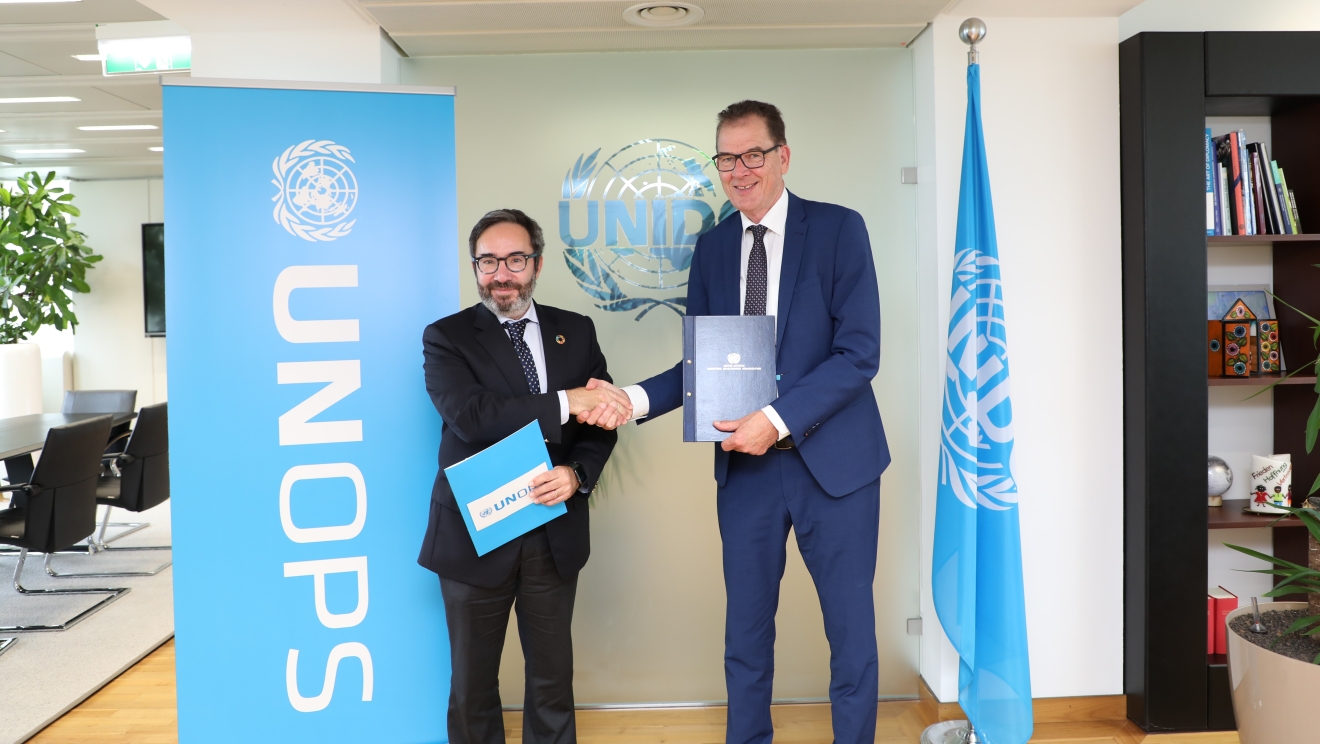
The Permanent Representative of Switzerland to UNIDO, Ambassador Rudolf Schaller and UNIDO Director-General Carlos Magariños, signed a Trust Fund Agreement on 26 September for a project that will enhance Tanzania's export capacity. Scheduled to run for three years with a budget of some US million, the project will assist Tanzania overcome existing, emerging and potential export barriers. In line with UNIDO's Trade Capacity Building Initiative, it will increase Tanzania's capacity to satisfy the growing number of investors and buyers who are demanding standards and testing certificates as "tickets of admission" to a range of trading and partnership activities.
Gerardo Patacconi, one of UNIDO's Trade Capacity Building specialists, told UNIDOScope that a very good synergy has developed between UNIDO's Trade Capacity Building Inititiative and the Swiss State Secretariat for Economic Affairs (seco) Trade and Clean Technology Co-operation Programme led by Jean-Pierre Cuendet. "The Tanzania project was one of a number of projects listed for UNIDO implementation on Switzerland's submission to the November 2004 meeting of the WTO Committee on Technical Barriers to Trade (TBT)" said Mr. Patacconi (see WTO document G/TBT/W/247). "We have a developed a working arrangement with SECO that ensures a win-win outcome for the donor, the recipient and the implementing agency" he continued. He referred to the document submitted by the Swiss to the WTO TBT Committee as describing the overall approach of Switzerland in the field of standards and technical regulations in a broad sense. To quote the document, the Swiss approach "encompasses not only TBT-related standards, but also SPS (Sanitary and Phytosanitary) measures [standards related to food safety, and plant and animal health] and even non-governmental labels, provided that these are relevant in international trade.
"The Swiss programme of technical cooperation in the field of standards and technical regulations aims at supporting developing countries and transition economies in effectively benefiting from market access opportunities in the world trading system by assisting them in meeting the requirements of international markets. ...Since the Doha Ministerial Conference in November 2001, the Swiss programme in the field of standards and technical regulations has been further strengthened and expanded to address the importance of having sound and efficient standard-related institutions, such as standardization, accreditation, and conformity assessment bodies, including certification agencies, metrology and testing laboratories."
The motivation behind the strengthening of the Swiss programme of technical cooperation and the launching of the UNIDO Trade Capacity Building Initiative were the same; both respond to the needs expressed in the WTO Doha Development Agenda. The UNIDO initiative recognises that despite ongoing efforts developing countries and especially least developed countries (LDCs) still remain excluded from growing international trade. For this to change, both tariff barriers and technical barriers to trade have to be removed.
![]() |
The UNIDO Trade Capacity Building Initiative stresses the need for development assistance to pay attention to the whole "product to market chain" For UNIDO, better integration of the developing countries in world trade requires above all the development of supply capacity, conformity assessment infrastructure, negotiating capacity and harmonized trade procedures. Developing countries must have the ability both to produce according to the standards and technical regulations set by the client countries, and have the infrastructure to assess conformity and to be able to offer proof of conformity that is accepted internationally. While compliance with standards and technical specifications is fundamental to all modern production processes, the rules-based system of the WTO also has to ensure that these standards and regulations are not abused and used to prevent the import of competitive products.
That is where the TBT and SPS agreements come in. They try to ensure that regulations, standards, testing and certification procedures do not create unnecessary obstacles to trade. They set out a code of good practice for the preparation, adoption and application of standards by central government bodies. To take advantage of these agreements, a country needs a sophisticated (and costly) "conformity assessment" infrastructure. Consequently the TBT and SPS agreements themselves are seen by some as non-tariff barriers, negatively affecting developing countries export capacity and participation in international trade. They are difficult to address since they form part of a complex system of standards and conformity assessment schemes with varying ties to government regulations. Even for experienced internationally operating companies, the diversity of technical requirements and certification schemes is far from transparent.
A principal precondition for compliance with the TBT / SPS requirements is to have the necessary regulatory framework in place. Some developing countries (particularly the LDCs) have yet to develop such a framework. The Tanzanian Quality infrastructure is relatively well developed for a LDC. In particular, the Tanzania Bureau of Standards (TBS) is a well-structured entity that is playing a key role in providing services to both Government and private sector in the quality chains for imported, exported and locally goods.
UNIDO has been providing technical assistance to foster Tanzanian industrial development and trade, specifically addressing TBT and SPS matters in the last few years (Phase II of the UNIDO Integrated Programme for Tanzania was launched in February 2005). As part of that assistance, UNIDO strengthened the Tanzania Bureau of Standards and the value and quality chains of agro-based sectors including fish, leather and sisal to improve supply-capacity and overcome barriers to trade. More recently, UNIDO carried out an assessment of the Food Control System in Tanzania as part of a Regional Programme on Harmonization of Food Control System in East Africa (2003) and conducted (2004-2005) two technical missions on Trade Capacity Building and SMTQ matters and fielded two experts (metrology and testing laboratories). This work enabled UNIDO to assess potential for export and constraints with respect to Standards, Metrology, Testing and Quality (SMTQ) weaknesses.
Furthermore, under the “Integrated Framework”, the Tanzania Diagnostic Trade Integration Study (DTIS) identified export market constraints; areas with high export potential, and issues that need to be addressed to enhance the export capability and competitiveness of the country. The DTIS study includes a Trade Related Technical Assistance Matrix of interventions covering agriculture, cut flowers, horticulture, spices, fisheries, honey, mining, and textiles. The DTIS report also identified the key challenges the country faces in the export area, specifically through an assessment led by the World Bank focusing on SPS matters. Weaknesses in the area of standards, metrology, testing and quality (SMTQ) are identified as major constraints that needs to be addressed to foster Tanzania access to export markets and to ensure protection of consumers.
In enhancing the capacities of the Tanzanian quality infrastructure, emphasis will be on the ability of the Tanzania Bureau of Standards to comply with TBT / SPS systems requirements and to deliver globally accepted metrology, testing, quality and certification services. A particular emphasis will be placed on the provision of these services to improve the quality chain for coffee and cashew nut production. The Standards Act (1975, amended 1977) under which the Tanzania Bureau of Standards was established (initially as the National Standards Institute) in 1976, is under review. An important item on the TBS review agenda is the separation and establishment of an independent subsidiary as service provider of training and consultancy on quality and other management systems to overcome possible conflict of interest with its certification activities.
In addition to building on the achievements of the UNIDO Integrated Programme for Tanzania, the design of the Swiss funded project takes advantage of the DTIS and World Bank studies and complements a number of other projects currently ongoing in Tanzania. In particular, the Danish international development cooperation agency DANIDA has expressed strong interest in collaborating on the establishment of a mechanism for policy dialogue on TBT / SPS standards. Other complementary projects are: the SECO project on Specialty coffee and Cashew nuts; the SECO regional / national projects in coffee and cashew; an EU project on proficiency testing for coffee (SPS/Ocratoxin A); and a PTB project on testing in East African Countries.
Under the UNIDO project, the capacities of the Tanzania Bureau of Standards and other institutions of the Tanzania quality infrastructure such as the Weights and Measure Agency, and the Tanzania Food and Drug Authority (TFDA), will be improved to provide metrology and calibration services including maintenance and accreditation, certification and testing services to institutional and private sector customers through mobile testing, measurement facilities, consumer packaging and implementation of quality and productivity improvement / management systems. Actions to achieve international recognition of tests, certificates and products will be also pursued to ensure access to export markets of Tanzanian goods and overcome potential barriers to trade.
The project will also strengthen technical and business relations between Tanzanian and foreign conformity assessment entities through UNIDO’s well established connections with a network of national, regional and international technical institutions, service providers, producers and experts. Special attention will be also given to facilitate transfer of know-how between Tanzanian and Swiss institutions dealing with standardization, training, certification, metrology, accreditation,packaging and import promotion.
In the preparation of this project, meetings took place in Tanzania between UNIDO and a large number of beneficiaries, counterparts, and development agencies. The meeting with the World Bank office in Dar es Salaam was particularly encouraging as it revealed shared objectives and good prospects for future cooperation. Specifically, as the UNIDO project addresses some of the constraints identified by the Bank’s Tanzania SPS study, a partnership could be established between the World Bank and UNIDO/seco to extend the scope of the UNIDO project to cover other SPS and TBT related issues which could lead to the upgrading and streamlining of the whole Standards, Metrology, Testing and Quality infrastructure.
A larger-scale trade capacity building project focusing on SPS matters could be developed to include: upgrading the Tanzania Food and Drug Authority; strengthening and promoting other Standards, Metrology, Testing and Quality public and private service providers; improvement of quality and safety related to the tourism industry (food safety controls in hotels/restaurants servicing tourists via awareness-raising, certification, surveillance, auditing, etc); improvement of quality chains and support for implementation of HACCP (the Hazard Analysis and Critical Control Points food safety management system), GAP (Good Agricultural Practices), and GMP (Good Manufacturing Practices) for key export products other than coffee and cashew nut; and the improvement of inspection, testing and certification of pharmaceuticals and other goods. For Tanzania's sake, lets hope the World Bank / UNIDO / seco partnership takes shape.
But back to the job at hand. Now that the signing formalities at UNIDO HQ are complete, Mr. Patacconi is off to Tanzania this month (October 2005) for phase one of this UNIDO / seco partnership.
Gerardo Patacconi, Tel: +43 1 26026 / 3605 E-mail: G.Patacconi@unido.orgcoming events
Send your comments to the editor: K.Timmins@unido.org